
Innovation
Tuesday, June 11, 2024
Explore the role of SEO in small business, including key types, local impact, cost efficiency, risks, and practical benefits for UK companies.

Role of SEO in Small Business Success
Competing with larger brands in busy British local markets can feel daunting for small business owners eager to be seen online. Strengthening your website’s presence is not just about visibility but about reaching customers exactly when they search for your services. By focusing on affordable SEO strategies and practical approaches tailored to your area, you can attract targeted, local visitors and give your business a sustainable digital advantage.
Table of Contents
Search Engine Optimisation For Small Businesses
Main Types Of SEO Strategies Explained
How Effective SEO Drives Business Growth
SEO Costs, Risks, And Long-Term Value
Common Mistakes And How To Avoid Them
Key Takeaways
Point | Details |
|---|---|
Implement SEO Strategies | Small businesses should prioritise targeted SEO techniques such as On-Page, Off-Page, Technical, and Local SEO to enhance online visibility and compete effectively. |
Focus on Content Quality | Creating high-quality, relevant content aligned with customer needs significantly drives user engagement and improves search rankings. |
Monitor SEO Performance | Regularly reviewing website analytics and updates is essential for keeping SEO strategies effective and adapting to market changes. |
Avoid Common Mistakes | Businesses must address technical misconfigurations and ensure proper keyword targeting to maintain strong search engine performance. |
Search engine optimisation for small businesses
Search engine optimisation (SEO) represents a critical digital strategy for small businesses seeking to establish a robust online presence. By implementing targeted SEO techniques, small enterprises can significantly enhance their visibility and compete effectively against larger competitors in the digital marketplace. Search engine optimization strategies provide small businesses an opportunity to reach potential customers precisely when they are searching for relevant products or services.
Successful SEO for small businesses involves multiple strategic approaches. Key techniques include conducting thorough keyword research, optimising website content, improving site performance, and building authoritative backlinks. Local SEO becomes particularly crucial, enabling businesses to target customers in specific geographic regions. By focusing on location-based keywords and maintaining accurate Google Business Profile information, small businesses can attract nearby customers searching for their specific services.
Implementing effective SEO requires understanding core ranking factors such as website expertise, authority, and trustworthiness. Small business owners should prioritise creating high-quality, relevant content that addresses customer needs while ensuring technical website elements like loading speed, mobile responsiveness, and secure hosting are optimised. Utilising free tools like Google Analytics can help track performance and refine ongoing SEO strategies, allowing continuous improvement of online visibility.
Pro tip: Invest at least two hours weekly reviewing your website analytics and updating your SEO strategy to maintain competitive digital positioning.
Main types of SEO strategies explained
Search engine optimisation encompasses several strategic approaches that work together to improve a website’s online visibility and search rankings. Core SEO strategy types typically include On-Page, Off-Page, Technical, and Local SEO, each addressing unique aspects of digital marketing optimisation. Understanding these different types allows small businesses to develop a comprehensive approach to improving their search engine performance.

On-Page SEO focuses on optimising individual web pages through strategic content creation, keyword integration, and metadata improvement. This involves crafting high-quality, relevant content that addresses user search intent, implementing appropriate header structures, and ensuring clean, descriptive page titles and meta descriptions. Off-Page SEO, conversely, concentrates on building website authority through external factors like quality backlink development, social media engagement, and online reputation management.
Technical SEO represents another critical component, addressing the backend elements that impact search engine crawling and indexing. This includes improving website speed, ensuring mobile responsiveness, implementing secure HTTPS protocols, creating XML sitemaps, and optimising site architecture. Specialised SEO approaches like Local SEO become particularly important for small businesses targeting specific geographic markets, involving tactics such as optimising Google Business Profile listings and generating location-specific content to attract nearby customers.
Pro tip: Conduct a comprehensive SEO audit quarterly to identify and address potential optimization opportunities across all strategy types.
Here is a summary of the main SEO strategy types and their primary business benefits:
SEO Strategy Type | Focus Area | Primary Benefit |
|---|---|---|
On-Page SEO | Content and metadata optimisation | Improves relevance and ranking |
Off-Page SEO | Backlinks and reputation | Builds authority and trust |
Technical SEO | Website structure and performance | Enhances crawlability and user experience |
Local SEO | Location-based targeting | Attracts nearby and local customers |
How effective SEO drives business growth
Search engine optimisation represents a powerful mechanism for driving sustainable business growth by systematically improving online visibility and attracting high-quality customer traffic. Data-driven SEO strategies enable businesses to create targeted digital marketing approaches that directly contribute to increased revenue and market positioning. By strategically aligning digital content with customer search behaviours, small businesses can effectively compete against larger competitors with more limited marketing resources.
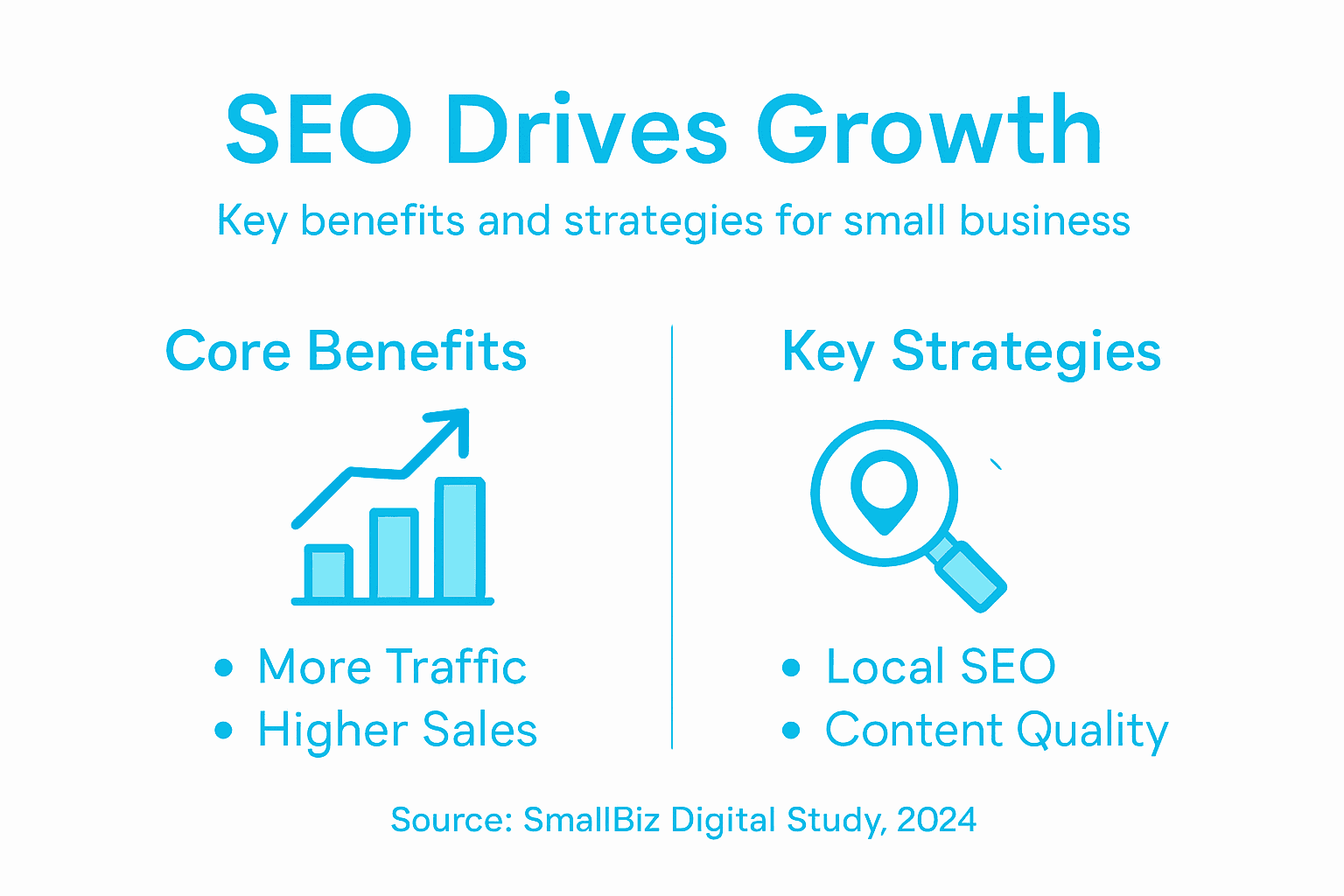
The mechanism of SEO-driven growth involves multiple interconnected processes that transform online visibility into tangible business outcomes. Organic search traffic generated through sophisticated keyword targeting allows businesses to attract potential customers precisely when they are seeking specific products or services. This targeted approach means higher conversion rates compared to traditional advertising methods, as businesses connect with audiences demonstrating genuine interest and immediate purchase intent.
Implementing comprehensive SEO strategies involves creating valuable content, optimising website performance, and building authoritative digital presence. By focusing on understanding user intent, developing high-quality informative content, and continuously improving website technical elements, businesses can establish credibility and trust with both search engines and potential customers. This approach not only improves search rankings but also creates a sustainable marketing channel that continues delivering results long after initial implementation.
Pro tip: Allocate consistent monthly resources to track and analyse your SEO performance metrics to ensure continuous improvement and strategic adaptation.
SEO costs, risks, and long-term value
Navigating the financial landscape of search engine optimisation requires small businesses to carefully balance investment with potential returns. SEO pricing models demonstrate significant variation, typically ranging from £500 to several thousand pounds monthly, depending on a business’s specific needs and complexity. Understanding these cost structures allows entrepreneurs to make informed decisions about allocating digital marketing resources strategically.
The inherent risks of SEO investment stem from multiple factors, including unpredictable search engine algorithm changes and increasing digital competition. Businesses must approach SEO as a continuous process rather than a one-time expense, recognising that sustainable digital visibility requires ongoing adaptation and refinement. Effective strategies involve monitoring performance metrics, understanding emerging search trends, and maintaining flexibility in content and technical optimization approaches.
Long-term value represents the most compelling argument for SEO investment, with organic search traffic providing substantially higher return on investment compared to traditional advertising channels. By creating high-quality, relevant content that genuinely addresses user needs, businesses can establish lasting digital authority and attract qualified leads consistently. The cumulative effect of strategic SEO efforts compounds over time, creating a sustainable marketing channel that continues delivering results without the recurring costs associated with paid advertising platforms.
Pro tip: Allocate at least 10-15% of your digital marketing budget to continuous SEO learning and implementation to maintain competitive digital positioning.
Common mistakes and how to avoid them
Navigating the complex landscape of search engine optimisation requires understanding and proactively addressing potential pitfalls that can undermine digital marketing efforts. Critical SEO mistakes often stem from technical oversights and strategic misunderstandings that can significantly impact a website’s search engine performance. Small businesses must remain vigilant about potential errors that could diminish their online visibility and organic search rankings.
One of the most prevalent challenges involves improper keyword targeting and content alignment. Many businesses mistakenly pursue generic, highly competitive keywords instead of focusing on specific, relevant search terms that match their unique value proposition. Technical mistakes such as inadvertently blocking search engine crawlers, using incorrect noindex tags, or neglecting mobile optimization can create substantial barriers to effective search performance. Understanding these potential issues allows businesses to develop more strategic and nuanced approaches to digital marketing.
Successful SEO implementation demands a holistic approach that balances technical optimization with high-quality, user-focused content. This involves conducting comprehensive keyword research, ensuring website accessibility for search engines, creating content that genuinely addresses user needs, and maintaining a responsive, fast-loading website across all devices. Regular audits and a willingness to adapt to changing search algorithms are essential for maintaining and improving digital marketing effectiveness.
To help small businesses avoid costly errors, here is a comparison of common SEO mistakes and their business consequences:
Mistake Type | Example Issue | Business Consequence |
|---|---|---|
Poor keyword selection | Targeting generic, broad terms | Lower rankings and weak traffic |
Technical misconfiguration | Blocking search engine crawlers | Pages not indexed or ranked |
Ignoring mobile optimisation | Non-responsive website layout | Loss of mobile visitors |
Neglecting website updates | Outdated content or slow speed | Reduced visibility over time |
Pro tip: Conduct a monthly technical SEO audit to identify and promptly address potential crawling, indexing, or performance issues before they impact your search rankings.
Unlock Small Business Growth with Expert SEO and Web Solutions
Small businesses often struggle with balancing budget constraints and the need for a strong digital presence that truly connects with their local customers. The article highlights crucial challenges such as effective keyword targeting, local SEO, and maintaining a technically optimised site to build trust and authority online. At Firefly Digital, we understand these pain points and provide tailored solutions that empower your business to stand out in competitive online markets. From designing visually appealing, responsive websites optimised for search engines to managing ongoing SEO strategies, we help you avoid common pitfalls like poor keyword selection and technical misconfiguration.
Transform your SEO efforts into measurable business growth with our comprehensive services:
Custom website design focused on user experience and search performance
Dedicated SEO management to boost rankings locally and beyond
Review management tools to build trust and credibility
Ready to see your small business succeed online? Visit Firefly Digital today and discover how our SEO management and custom web design services can give you a competitive edge. Don’t wait to optimise your digital presence with expert support designed specifically for small businesses competing in today’s fast-paced online marketplace.
Frequently Asked Questions
What is the importance of SEO for small businesses?
SEO is crucial for small businesses as it enhances online visibility, enabling companies to reach potential customers searching for relevant products or services. Effective SEO strategies allow small businesses to compete against larger competitors in the digital marketplace.
How can local SEO benefit a small business?
Local SEO helps small businesses attract customers in specific geographic regions. By optimising for location-based keywords and maintaining accurate Google Business Profile information, businesses can effectively reach nearby customers looking for their services.
What are some common SEO mistakes that small businesses should avoid?
Common SEO mistakes include poor keyword selection, technical misconfigurations that block search engine crawlers, and neglecting mobile optimization. Each of these errors can significantly impact a website’s search engine performance and visibility.
How can small businesses measure the effectiveness of their SEO strategies?
Small businesses can measure SEO effectiveness using tools like Google Analytics, which track performance metrics such as organic traffic, conversion rates, and user engagement. Consistent analysis of these metrics helps refine and improve ongoing SEO strategies.
Recommended
Related articles
Our platform is designed to empower businesses of all sizes to work smarter and achieve their goals with confidence.



Ignite your Firefly journey today!
Whether you seek social media marketing expertise, professional web design, or the perfect SEO strategy for your brand, our mission is to support you in reaching your goals through Web Design, SEO, Social Media Management & More.

Our Services
Subscriptions
Existing Clients